Here’s a quick exercise to contemplate.
At your organization’s next all-hands meeting, try to count the number of people over 50. Then determine how many team members are under 30.
Now ask yourself a question you’ve probably never considered: what happens when older workers leave or when there aren’t enough young people to fill their shoes?
Spoiler alert: the question is not “if” but “when.”
Decades of institutional knowledge—the kind that doesn’t live in a shared Google Drive or a Notion page—is slowly but assuredly walking out the door.
The person who knew why that client relationship survived 2008. The engineer who could hear a problem in the production line before the data caught up. The account executive who knew their client’s favourite wine. Gone.
And nobody thought to ask them what they knew before they left, because nobody thought they were leaving. (Whether by retirement or termination.)
Add to this flummoxing organizational reality the fact that birth rates have been plummeting since the early 1970s, right across the world. Does anyone see the inevitable reality that the hunt for talent will rapidly increase, primarily because fewer younger workers are coming up the talent pipeline?
The compounding, invisible loss of wisdom and the diminishing stream of younger workers to replace it—among several other demographically related topics—are the subject of my sixth book, The Future of Work Is Grey: The Untapped Value of Age in the Workforce.
I wrote the book because not only do these numbers and scenarios scare me, but the organizational response—or, more to the point, the stunning absence of one—is arguably frightening me more.
The Debt No One Is Counting
According to the World Economic Forum, workers aged 55 and older in G7 countries will account for more than 25 percent of the workforce by 2031. That’s nearly 10 percentage points higher than in 2011.
I think the World Economic Forum is underselling the number. I suspect it will be higher.
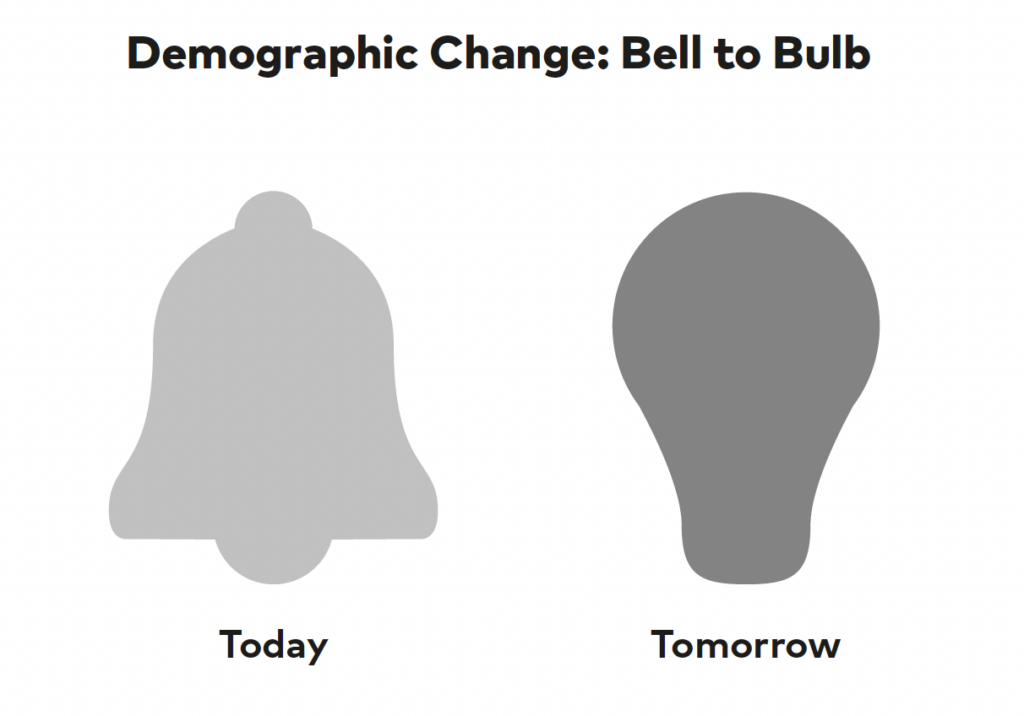
Meanwhile, birth rates are cratering across every industrialized nation. The traditional workforce model—where younger workers steadily replace older ones in a neat, bell-shaped flow—has broken.
That bell-shaped demographic trend we thought would continue ad infinitum? It’s becoming a light bulb. Fewer young workers at the base, a thick band of mid-career professionals jammed in the middle, and a growing population of experienced veterans crowding the top.
Japan is already there. Twenty-nine percent of their population is over 65, projected to hit 40 percent by 2050. Germany, Italy, and France are nearly there. Canada and the U.S.? Give it a decade, because it is most definitely happening.
I call this miscalculation Age Debt: the organizational failure to account for aging populations, plummeting birth rates, and the wisdom gaps that follow. Age Debt is the workplace equivalent of the climate crisis—you know it’s building, but you only believe it when the flood or fire reaches your door.
And the cost of ignoring it?
Replacing lost expertise runs between 0.5 and 2 times the employee’s annual salary, according to Gallup. Multiply it across your entire workforce of older workers, and tell me the number doesn’t make your stomach turn.
Forget Generations
Millennials, Boomers, Gen Z. I’m done with these labels, even my beloved Gen X characterization. What generations create in the workplace are birth-year stereotypes masquerading as workforce strategy. They tell you almost nothing about what someone actually contributes.
In the book, I replace them with three career eras, much like a Taylor Swift Eras Tour.
Rivers are early-stage contributors—curious, energetic, fluid in their thinking.
Rocks are mid-career professionals who stabilize teams, anchor execution, and carry the operational weight.
Rubies are the veterans with crystallized wisdom, institutional memory, and the kind of tacit knowledge that AI will never replicate.
Everyone moves through these eras. You, me, your parents, and your kids.
Your workforce is a constantly shifting mix of Rivers, Rocks, and Rubies, and if you’re still segmenting by generation, you’re solving the wrong puzzle with the wrong pieces. Generational stereotypes exacerbate the issue of Age Debt.
Flip the Record
The Future of Work Is Grey is structured like a vinyl album, mostly because I have a very serious side hobby of studying music.
Side A—five tracks—diagnoses Age Debt. It follows demographics, knowledge, ageism, and longevity issues.
Side B flips to something I call the Experience Dividend, the polar opposite of Age Debt. At its core, the Experience Dividend is workforce strategy that treats experience and age as a long-term investment, not an expense line to be trimmed at every restructuring cycle.
Three frameworks make Side B worth turning the album over.
First, the Career Canvas replaces the career ladder, which belongs in a museum alongside the myth that people change jobs seven times. (The U.S. Bureau of Labor Statistics says 12.4, but who’s counting?)
Second, the Wisdom Wheel ensures institutional knowledge gets captured, nurtured, and renewed before it disappears. Wisdom is to the Experience Dividend what oxygen is to fire.
And third, the Longevity Lens builds the organizational conditions—culture, leadership, financial clarity, well-being, and workplace design—that enable Rivers, Rocks, and Rubies to thrive at every stage.
Those three Experience Dividend frameworks are your keys to combatting Age Debt.
Why Grey?
The title of the book is quite deliberate.
Grey is where the real answers live—between “always remote” and “always onsite,” between “too young” and “too old,” between a rigid career ladder and formless career portfolios, between not realizing to living past the age of one hundred to organizations helping people to plan for it.
Grey. That’s where the colour lies.
You can’t hide from demographic reality. It’s coming for every organization and leader.
The Future of Work Is Grey is available on May 5 in North America and June 22 globally.
I hope you get the chance to “go grey.”