

Abraham Maslow once wrote, “It isn't normal to know what we want. It is a rare and difficult psychological achievement,” but I contend team members ought to try to prove Maslow wrong. Aldous Huxley perhaps provided a positive antidote, when he wrote, “Knowing who in fact we are results in Good Being, and Good Being results in the most appropriate kind of good doing.”
It is critically important to know thyself ... if one wants to achieve a sense of purpose in life or at work.
[caption id="attachment_15987" align="alignright" width="377"] Shutterstock[/caption]
Kelsy Trigg, a leader in the high-tech space, was having dinner with me one night in 2011 when she shared her personal purpose statement. Kelsy highlighted something that night that really made me think.
Shutterstock[/caption]
Kelsy Trigg, a leader in the high-tech space, was having dinner with me one night in 2011 when she shared her personal purpose statement. Kelsy highlighted something that night that really made me think.
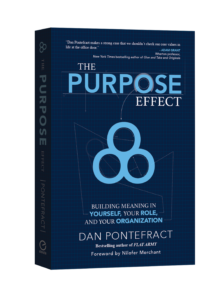 ____________________
PS. Read more in my latest book, The Purpose Effect: Building Meaning in Yourself, Your Role and Your Organization
Download Chapter 1 ... for free!
Audible version now available, too. (I'm the narrator!)
____________________
PS. Read more in my latest book, The Purpose Effect: Building Meaning in Yourself, Your Role and Your Organization
Download Chapter 1 ... for free!
Audible version now available, too. (I'm the narrator!)
Shutterstock[/caption]
Kelsy Trigg, a leader in the high-tech space, was having dinner with me one night in 2011 when she shared her personal purpose statement. Kelsy highlighted something that night that really made me think.
- Do people who exhibit purpose define themselves with some form of personal purpose statement?
- I decide to live my life filled with joy.
- I decide to be generous, open-hearted, and loving.
- I decide to show up whole-heartedly and be present.
- I choose courage, integrity, peace and love.
“For me, the language ‘I decide’ is very powerful, whether it’s deciding how I show up or deciding what my next step in something is. This doesn’t ensure a particular outcome or necessarily impact those around me, but it does provide a sense of grounding and choice about how I respond to my internal and external environment, no matter what my surroundings hold. When I internalized this, it brought a sense of calm for me. My happiness is my responsibility. How I show up is my choice.”Two points come to mind with respect to Kelsy:
- Defining yourself through a personal purpose statement is an important step in the quest for workplace and life purpose.
- Individuals should not be afraid to revisit the statement over time to determine if it continues to resonate.
"Who am I in life and at work?"There is no one right answer, nor should it be viewed as a competitive task against peers and friends. It is an ongoing definition not a one-time commandment. It can occur in your 20s or your 90s or at several points in between. Philosophers and leaders like Plato, Socrates, Heraclitus or Pythagoras, were alleged to have bandied about the maxim “Know Thyself” in the agora on many an occasion. Self-understanding—knowing oneself—is essential to this. It leads us to surface a critical point. Personal purpose is the perpetual journey to continually develop, define and decide your what, who and how. When we ask these questions we commit to develop, define and decide our calling, our personal purpose. We pledge to begin knowing thyself. Constantly redefining who one is in life and at work increases the likelihood that your personal purpose will be realized. Being relentless in the quest for personal purpose is key to achieving the sweet spot. An excellent starting action is to define one’s self through a personal declaration of purpose. It may change over time. That can actually be healthy. The key point, however, is to take the time to define it and, ultimately, to know thyself. Just like Kelsy.
____________________
PS. Read more in my latest book, The Purpose Effect: Building Meaning in Yourself, Your Role and Your Organization
Download Chapter 1 ... for free!
Audible version now available, too. (I'm the narrator!)


