

Over the last several months, at the job that actually pays me, I’ve been on somewhat of a soapbox speaking, writing, blogging, yammering about the link between culture, leadership philosophy and Enterprise 2.0 technologies.
In summary, as we shift to a new decade replete with Moore’s Law in abundance, we need to recognize that yesterday’s way of leading needs to be improved but it cannot do so unless Enterprise 2.0 technologies become part of that new philosophy. One without the other will cause either confusion or ambivalence.
Today, many companies have leadership development training and programs. But, do those companies have an actual leadership philosophy that speaks to everyone in the organization, in a society that is shifting towards ‘cultivate and coordinate’ from ‘command and control’? Are those leadership development programs including a new attitude, a new DNA, a new bedrock that starts first with the notion that everyone at the company is in fact a leader?
Does it start with the principle tenet that we need to open our doors, tear down the cubicles, and invite the entire organization to the table before making decisions or inventing the next new shiny object?
Does it flatten the organization? (with certain situational hierarchy aspects upheld, such as performance management practices, hiring approvals, budget setting, M&A, etc.)
And in doing so, that is by developing a leadership philosophy that is open, connected, network-based and inclusive to all, we marry the new-found hope of Enterprise 2.0 technologies.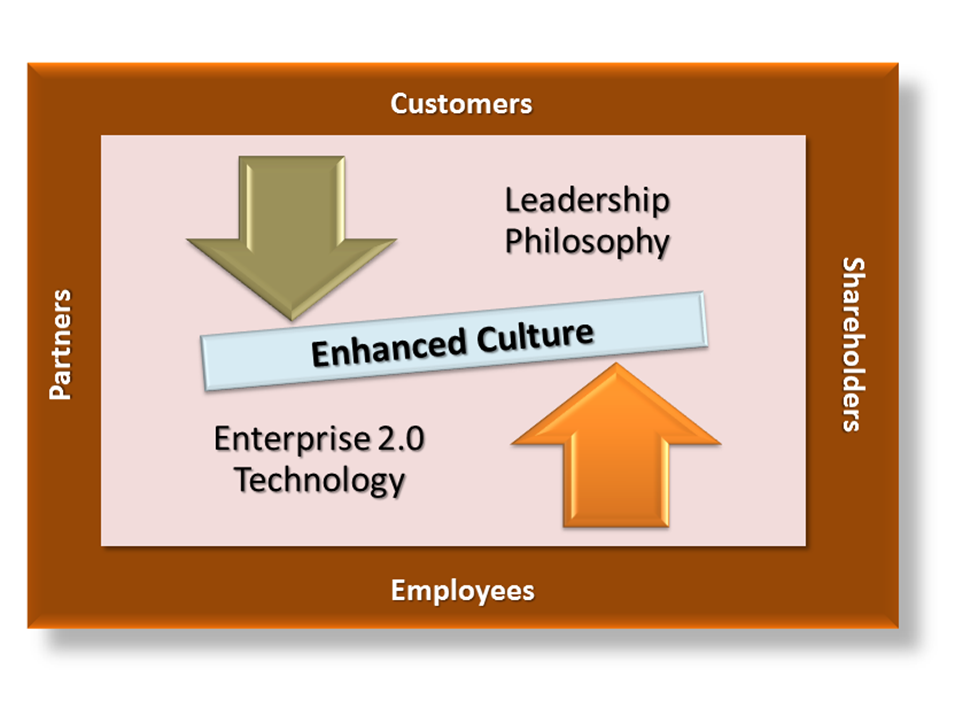 Social computing inside of the enterprise is changing the game. It is breaking down silos, opening up doors, building relationships … and … eventually, improving productivity, efficiencies and ideally revenues/profits.
The general bucket of Enterprise 2.0 tools, applications and ideas is in fact a critical piece to the new leadership philosophy of tomorrow. If, however, an organization doesn’t either include the technologies into the leadership philosophy or (worse yet) thinks an organization can prosper by merely implementing disparate E 2.0 technologies across the organization, the new leadership philosophy will stagger in an ecosphere of misunderstanding.
The two must marry if an organization wishes to be successful in the culture of tomorrow.
Hewitt Associates conducted a Cost Reduction and Engagement Survey in April 2009 with 518 US based companies. There are two tell-tale points that resonated with me:
Social computing inside of the enterprise is changing the game. It is breaking down silos, opening up doors, building relationships … and … eventually, improving productivity, efficiencies and ideally revenues/profits.
The general bucket of Enterprise 2.0 tools, applications and ideas is in fact a critical piece to the new leadership philosophy of tomorrow. If, however, an organization doesn’t either include the technologies into the leadership philosophy or (worse yet) thinks an organization can prosper by merely implementing disparate E 2.0 technologies across the organization, the new leadership philosophy will stagger in an ecosphere of misunderstanding.
The two must marry if an organization wishes to be successful in the culture of tomorrow.
Hewitt Associates conducted a Cost Reduction and Engagement Survey in April 2009 with 518 US based companies. There are two tell-tale points that resonated with me:
Social computing inside of the enterprise is changing the game. It is breaking down silos, opening up doors, building relationships … and … eventually, improving productivity, efficiencies and ideally revenues/profits.
The general bucket of Enterprise 2.0 tools, applications and ideas is in fact a critical piece to the new leadership philosophy of tomorrow. If, however, an organization doesn’t either include the technologies into the leadership philosophy or (worse yet) thinks an organization can prosper by merely implementing disparate E 2.0 technologies across the organization, the new leadership philosophy will stagger in an ecosphere of misunderstanding.
The two must marry if an organization wishes to be successful in the culture of tomorrow.
Hewitt Associates conducted a Cost Reduction and Engagement Survey in April 2009 with 518 US based companies. There are two tell-tale points that resonated with me:
- 47% of companies surveyed reported a decline in employee trust as a result of the way in which they have managed their cost reductions in 2009
- Top investment actions currently being undertaken during the difficult economic times of 2008 and 2009 include leadership development (47%) and manager capability training (35%)
Almost half of the organizations recognize that employee trust is declining due to the cost reduction measures put in place. But imagine if there were a leadership philosophy in place that allowed everyone to more fully understand what was happening, why, and ultimately being involved in the ‘idea generation’ of solving some of the problems? That would be powerful.
And secondly, I find it ironic that the top investment actions undertaken included leadership development and manager capability training. They really should have started developing not formal training programs, but an updated leadership philosophy AND enterprise 2.0 strategy so that when the next economic meltdown occurs, organizations will be prepared to handle issues better and engagement/trust would not take a beating. The fine folks over at Redcatco, I think, said it best:The traditional IT and management paradigm is that we are a collection of individuals using IT tools. That frame misses the most powerful forces that business leaders have at their fingertips. A business is a community, and sometimes multiple communities, that communicate and interact with each other (both intra- and inter-). That interaction is increasingly dominated by technology-mediated communication, and that communication (or collaboration) technology is less neutral than people think. It can be culture forming.


